Tuesday, May 12, 2015

Orange, France : Sampling Provence

What comes to mind when Provence is mentioned?  Before this trip I would have said a climate like that of where we grew up in Southern California -- mild, dry, and lots of sunshine.  We took a few days to travel up one river valley, over a pass, and down another valley to find out if our preconceptions were true.  And we confirmed that, yes, the skies can be a brilliant blue day after day.  But it also rains and the wind can blow, really hard, just like at home.
Artichokes and chateaus, an unexpected Provence combination.

Crossing the Durance under a brilliant blue sky.
We followed the Durance river valley east from St Remy under brilliant blue skies.  We traveled minor roads through small agricultural towns.  Lots of peach and olive trees and vineyards.  By afternoon the winds were blowing enough to get our attention and get John’s allergies flaring.  We later learned we experienced a taste of the mistral winds, a weather phenomenon that affects Southern France and especially Provence.  The day we crossed over the Luberon range it was the opposite -- damp, cloudy, cold, which makes for disappointing pictures. 
Looking east as we cross the Luberon range on a gray day.

Sunset at our campsite next to a wheat field as the clouds clear.

These bell towers are open to allow the mistral winds to pass through.
We continued west towards Apt and then to Avignon.  This area gets a great number of visitors, and it is what most people think of Provence.  Lavender fields, olive orchards, vineyard after vineyard, wine tasting until you can’t legally drive anymore.  We saw the emerald pools and filled our water bottles at the spring of Fontaine de Vaulcluse.  We did not partake of the temptations of ice cream and souvenirs on the half-mile walk up to the spring, where water flows out of the mountainside.  And we timed our arrive into Apt on the day of their huge weekly market that wound up and down the streets of the old town, succumbing to those temptations and feeding ourselves with an alarming number of calories from the many food stalls.
The streets of Apt are crowed with vendors, shoppers and street musicians on Saturdays.

The French love their flowers, like these on sale at the market in Apt.

Provence olives!

Fresh garlic at the market in Apt.

Hedge trimming taken to the next level.

Vineyards everywhere as we go from Apt  to Avignon.

Just another Provence hilltop town.

These limestone walls went for miles, and red poppies are everywhere, too.

the emerald waters of the Fontaine de Vaulcluse.
One more day and we were in Avignon on the Rhone river.  For 100 years in the 14th century this was the place the popes lived.  There were nine popes that ruled in that period, and they built a palace, a fortress really.  And for a fee you can walk through the various buildings that are now bare, devoid of the opulence that must have existed during that time.  The structures that comprise the palace evolved over time, each pope adding on or reconstructing portions of the complex.  My favorite room was the treasury, where the gold was stored in vaults in the floor with lids that could only be lifted with pulleys.  To me that was the power center of the place.
The view of Avignon at sunset from our campground across the Rhone.

View of the Pont Saint-Bénézet and the Rhone from the gardens of the Palais des Papes.

Backside of the gilded statue of the Palais de Popes.

Palace or fortress?  You decide...

This was the kitchen.

Massive wood doors in the chapelle.

Another view of the mish-mash of buildings of the palace.
Our small tour of Provence ended in Orange, just north of Avignon.  The town itself is nothing special, other than the massive and well-preserved remains of a Roman theater, the best in Europe.  Others like it were dismantled and the stones reused for other purposes, but King Louis XIV like the looks of this one and saved it in the 17th century.  Performances are still staged there, and one of the exhibits showed film clips from what was described as “Europe’s Woodstock” in the 1970‘s with Frank Zappa doing his thing on that ancient semi-circular stage.  The acoustics of the venue are excellent, and were demonstrated to us while we stood at the very top tier of the seats.  A group of German students in front of the stage and sang a portion of Beethoven’s Ode to Joy, which carried clearly up to where we stood.

Too big for one picture....
...so I took two!

Corridor around the perimeter of the seating area of the theater.

The impressive Triumphal Arch of Orange on the way out of town.
We left Orange to return to the Rhone, leaving Provence with our preconceptions replaced with memories.

Wednesday, May 6, 2015

St. Remy de Provence: The Romans Slept Here

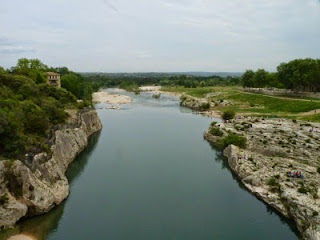
We waited out a rain event in Florac at the edge of the Cévennes, then up and over a pass and then it was all downhill to our goal, the city of Nimes.  We dropped down to the coastal plain following the Gard River.  And just like the Romans who dominated this area over 2,000 years ago, we needed to cross the river to get to the other side.
First view of the Pont du Gard
Nimes was a prosperous town in Roman times with a population of over 60,000 people.  To support the people and industry, water was transported from the north via aqueduct, and the Pont du Gard is a remnant of this aqueduct that spans the Gard.  We arrived at the entrance gate mid-morning along with a stream of cars.  For some reason we thought we were early enough to have the place to ourselves.  We found out we could wheel our bikes across, so we entered the area, passing through a canopied mall with the standard food and souvenir shops, but also a nice display of all the other UNESCO World Heritage Sites and Grand Sites of France locations.  We exited the 21st century commercial zone, turned the corner, and there was this immense and impressive structure.  In an instant the Disneyland atmosphere evaporated and here was this massive spectacle of Roman engineering. 
Find the man in orange in this picture.

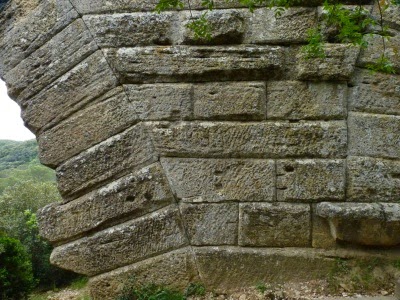
No mortar was used in construction of the aqueduct.

People were scattered on the banks of the Gard, enjoying a weekend picnic.

Aqueduct supports, all in a row.

My lucky day -- the sun came out for ten minutes so I could take this picture!
We spent the next couple of hours circling it from every vantage point.  There were people everywhere on the bridge taking selfes or having picnics below on the banks of the river.  But no matter how long all of us looked and lingered, it would never be as long as it took to build it or how long it has remained standing.
The weathered limestone of the Arena in Nimes.
It was overcast and muggy on our layover day in Nimes, gray and dingy just like the limestone of the Romans sights in the old city.  We visited the immense amphitheatre, and the entrance price included an audio guide.  Interesting, although there were a few more details of gladiator fights and feeding prisoners to the lions than we cared for.  We connected the dots through the city to other Roman hot spots -- the Maison Carrée, the Temple of Diana, the Tour Magne, the city gardens. 
The inside of the Arena, where workers were clearing aparatus from the weekend's gladiator renactments.

View of Nimes from the highest tier of the Arena.

Tourists enraptured by their audioguides.

Contrast of the pre- and post-renovated sections of the Arena.

Columns of the Maison Carrée.

Waterway in Nimes fed by deep springs.
Arles was also an important city for the Romans and we did a quick pass through the town on our bikes after leaving Nimes.  There are remains of an arena, although smaller and different in character from the one in Nimes, as well as baths, a theater, and an impressive cathedral from the Middle Ages.  Vincent Van Gogh spent time in this city because he loved the light.  And this is where we first crossed the Rhone River, the subject in my favorite of Van Goghs’ paintings -- Starry Night Over the Rhone. 
Plein air artist in the main square of Arles. 

Remnants of the Arena in Arles.

Detail of the facade on the cathedral in Arles.  I am not sure what is going on here, but it doesn't look good.
On our way to our campsite that night we took a right turn where the sign indicated there were some Roman ruins.  We looked around, and right next to an orchard of olive trees there were the remnants of an aqueduct, diminutive in comparison to the Pont du Gard, but with no entrance fee and with the look that it has been ignored since the Romans abandoned it centuries ago.  Thanks to Wikipedia we now know it was the site of 16 water wheels that powered a flour mill with a capacity to produce 4.5 tons of flour a day.  And here it sits overlooking the wheat fields in the valley to the south just waiting to be discovered by us.
Roman mill water works near Barbegal.

Sections of the aqueduct in place where they fell.

Looking north towards the Alpilles on the first sunny day in a long time.
That night I looked up in the sky and noticed that the moon was nearly full and breeze was blowing.  It occurred to me that I had not seen the moon for at least a week.  The mugginess blew out by morning, and we had brilliant blue skies.  We were now in Provence, in the town of Saint Remy.  On the outskirts is the Glanum archaeological site, a Gaul settlement in the 6th and 7th centuries BC, and then a Roman colony until the middle of the 3rd century AD.  A good day for taking pictures and discovering something old, but new for us.
Roman columns unearthed at the Glanum archeological site.

Amazing that this fountain was unearthed where the thermal baths were located.

Pillars with inscriptions.  Sorry, no translation.  I am having enough trouble with French.

It is not hard to imagine the layout of the town from the excavated walls.
So at the end of this little mini-Roman tour, I believe I am starting to think like a European.  We stayed in a campground one night and the reception office was inside the building where the campground operators lived.  The room had high arched ceilings like a church.  I asked how old the building was -- the mademoiselle said maybe 300 years.  Not that old.  Structures from the 12th century are everywhere -- churches, walls, fortresses on hills -- and are still used.  Not unusual.  And Roman structures from 2,000 years ago are just old.
Overview of Glanum, looking north into the heart of Provence.

Thursday, April 30, 2015

Gorges du Tarn, France: Cathedrals of the Natural Kind

The storm that kept us grounded an extra day in Albi lingered long enough to give us lead-gray skies on the morning we left the city.  But the roads were dry and the chilly wind was at least to our back.  We followed the Tarn the entire day, running chocolate brown and high from the storm.  We followed a small road alongside the river that was a former railroad bed, so the grade was even with no surprises.  Water trickled down side canyons and in grottoes along the way.
The Tarn running mighty and muddy.
The further we got from Albi, the smaller the villages and almost no traffic.  We must have passed through half a dozen tunnels, some almost a kilometer long.  The first one had lights the entire length, but not the others.  We had to dig out our headlamps to light the way, but it still was quite disorientating tending to vertigo to ride in those black tubes.
Old railway tunnel along our road with a characteristic horseshoe shape.
By afternoon the clouds dissipated and so did the railroad grade and we were going up and down most of the afternoon.  There were three hydroelectric projects on the river along the way.  It was a long day for us, 95 kilometers, and we pulled late into the campground.  It seems to be still early season in this area -- we were the only campers, and maybe two other parties occupying cabins. It was a very nice facility -- four stars.  We are not quite sure exactly what that means, but we know it has something to do with services they offer. And this one had toilet paper.  I am thinking of compiling a chart of star rating vs toilet paper availability to confirm this theory.
Hydroelectric project along the Tarn.

Green, green...

...everywhere
John’s thermometer read 3 degrees the next morning, but it didn’t seem so bad once we remembered in was Celsius.  The highlight of the morning was passing under the Millau Viaduct, the tallest bridge in the world.  Astounding in scale.  And on this day we entered the Gorges du Tarn.

See my little bike?  Just a toy in comparison to the bridge!

Very, very impressive.

The other viaduct.
The Gorges du Tarn is a 50-kilometer canyon carved by the Tarn river.  A persistent limestone caps the top of the canyon walls which become quite narrow and steep, with shales and schists below.  Occasionally we would pass a cave with a heavy wooden door, presumably with some aging cheese behind it.
Entering the Gorges du Tarn.
Hiking, climbing, spelunking, white-water rafting and kayaking are big sports in the area.  We understand it gets very crowded in July and August, and the campground density is quite high all along the river.  But we are early season, and we found out that open campground density is quite low.  So we cycled further than we intended and ended up in a campground where most of the fellow occupants were climbers, many which we saw scaling the cliffs above us on the way in.  They had the look of the climbers back home -- minimalist, friendly, lean and dressed in puff jackets.
Bonjour!

The building stone in the area is more varied than the limestone of the Dordogne and Lot valleys.


We exited the canyon the next day, the first day of full sun in a while, stopping often to take pictures of chateaus and cliffs and the river.  Pardon the pun, but it was “gorge-ous”.  Our road was near river level, but serpentine roads branched off frequently and we could see them switchbacking up the canyon to the high plateau into the reaches of the Cevennes region.  I wanted to follow those roads, but it would have to be some other time, some other mode of travel.


Translate

Copyright

All original text and photos are copyrighted Doris Reilly © 2006-2023. No part of the content or the blog may be reproduced without prior written permission.
Powered by Blogger.

Contact Form

Name

Email *

Message *