
Peloponnese, Greece: Two Weeks in Pictures
Two weeks, four bike tourists, one peninsula. And a whole bunch of photos. So if you have some time, scroll on down and enjoy some of our favorite images and a few memories. And if you want to see our route, go to the "Routes" menu item at the top of the header, or click on this link.
Ann and Joe, our cool neighbors and travel buddies, left us this morning to continue on their own back to Athens and then home to California. We are now better friends, after sharing the challenges of thunderstorms, uphill grinds, and dirt-bag campsites. But also the beauty of spring wildflowers, ruins of ancient civilizations, and moussaka. Tomorrow we cross this bridge and continue north to mainland Greece and beyond. Stay tuned.
Ann and Joe, our cool neighbors and travel buddies, left us this morning to continue on their own back to Athens and then home to California. We are now better friends, after sharing the challenges of thunderstorms, uphill grinds, and dirt-bag campsites. But also the beauty of spring wildflowers, ruins of ancient civilizations, and moussaka. Tomorrow we cross this bridge and continue north to mainland Greece and beyond. Stay tuned.
 |
| We rented an AirBnB in central Athens for three nights. The rooftop had a view of the Acropolis, as well as the tatoo parlor across the street and Death Disco a few doors away. The host thoughtfully left complimentary earplugs on the bedside tables, but luckily we were there on the nights the disco was closed. |
 |
| We walked to the top of the prominent hill where the Acropolis was located first thing in the morning to get the best light and beat the crowds. Here is my token image of the Parthenon. |
 |
| The Caryatid Porch of the Erechtheion, dating from 421-407 BC. These are replicas. The originals are in the Acropolis Museum, which we visited later in the day. |
 |
| Ruins overlooking the modern city of Athens. |
 |
| The structures built on the hill of the Acropolis are right on top of an irregular surface of massive limestome. |
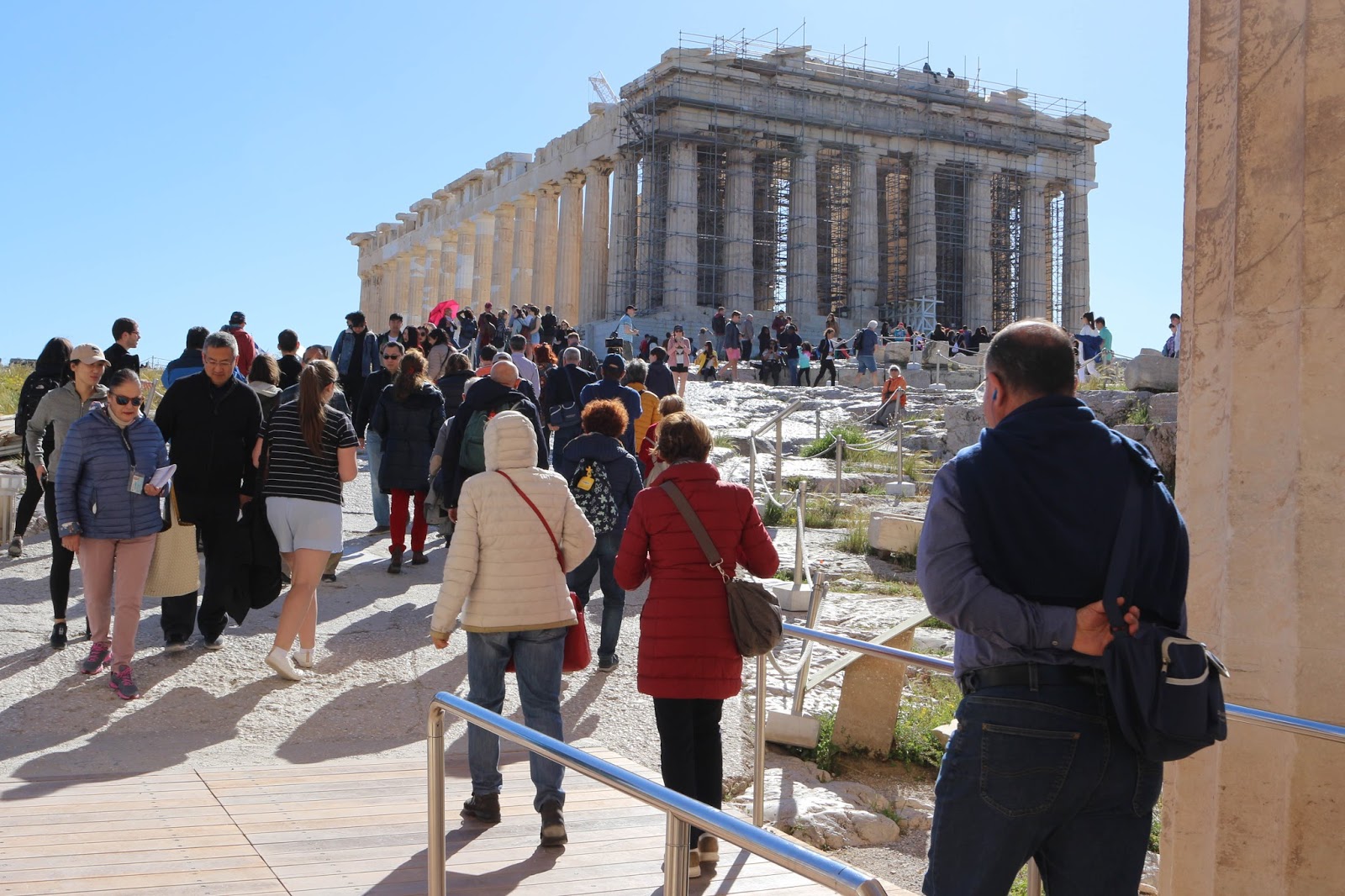 |
| We finished our stroll on the hill just as the throngs of visitors arrived. |
 |
| Red poppies were blooming everywhere. |
 |
| The Acropolis Museum, at the base of the hill, preserves and artfully displays artifacts from the site. |
 |
| There is some bad stuff going on here. |
 |
| The next day we walked to the National Archeological Museum of Athens, and encountered the central market. |
 |
| All this carnage could drive one to... |
 |
| ...vegetables! |
 |
| Inside the museum were artifacts from the Neolithic era, as early as 6,000 BC. The pottery collection was large, with many artifacts in near-perfect condition. It is striking how form and function were combined perfectly into objects of beauty, I was particularly taken with the vases with long spouts in the form of a bird. |
 |
| Aphrodite, Eros and Pan |
 |
| The museum had several artifacts found in shipwrecks, including this torso, as well as bronze sculptures. |
 |
| After two days in Athens, we took the train to Corinth to the west to avoid traffic in the suburban sprawl. It takes a bit to get the jet-lagged legs moving and managing our two-wheeled luggage carriers. |
 |
| Ann and Joe, outstanding in a field! |
 |
| Our first big site outside of Athens was Mycenae, dating from the second millenneum BC. The famous Lion Gate is the main entrance to the citadel. |
 |
| Wildflowers were in abundance everywhere. Spring is a good time in this part of Greece...mild temperatures, too. |
 |
| Heinrich Schliemann, a German archeologist, excavated these ancient graves in 1876 and found a spectacular wealth of artifacts. |
 |
| The small museum at the site had all kinds of ancient treasures. |
 |
| Including "stirrup vases". |
 |
| The entrance to one of several beehive tombs. |
 |
| The interior brick structure mimics the shape of a beehive, lending great strength to the structure. Appropriately, wasps made their nests in the chinks between bricks and where continuously buzzing inside the dome. |
 |
| Hey, I know those three! |
 |
| We returned to our chained bikes and found a local dog guarding them. Dogs are everywhere in Greece. A yard will often have more than one clamoring to get at a passing cyclist. And barking dogs were the sound of the night in just about every campsite. |
 |
| End of the day, returning down the hill from the Mycenae site to our campground. |
 |
| Four happy bike tourists, all in a row. |
 |
| We passed through the seaside town of Nafplio on Good Friday. |
 |
| It has has a fortress on a hill with some impossible steps, which we did not have the time to climb. |
 |
| And another little fortress on an island in the harbor. |
 |
| 95% of Greece are Greek Orthodox, and churches with characteristic domed roofs are everywhere. Most are very small, and some small villages will have several. This one, however, was quite large and stunning outside and inside. |
 |
| We found a Greek family campground, not yet open for the season, that let us stay the night. Thunder and lightning and a sustained downpour forced us to shelter under the rigged canopy of of one of the units to cook dinner. |
 |
| The next day the skies were still heavy with humidity as we traveled along the coast. |
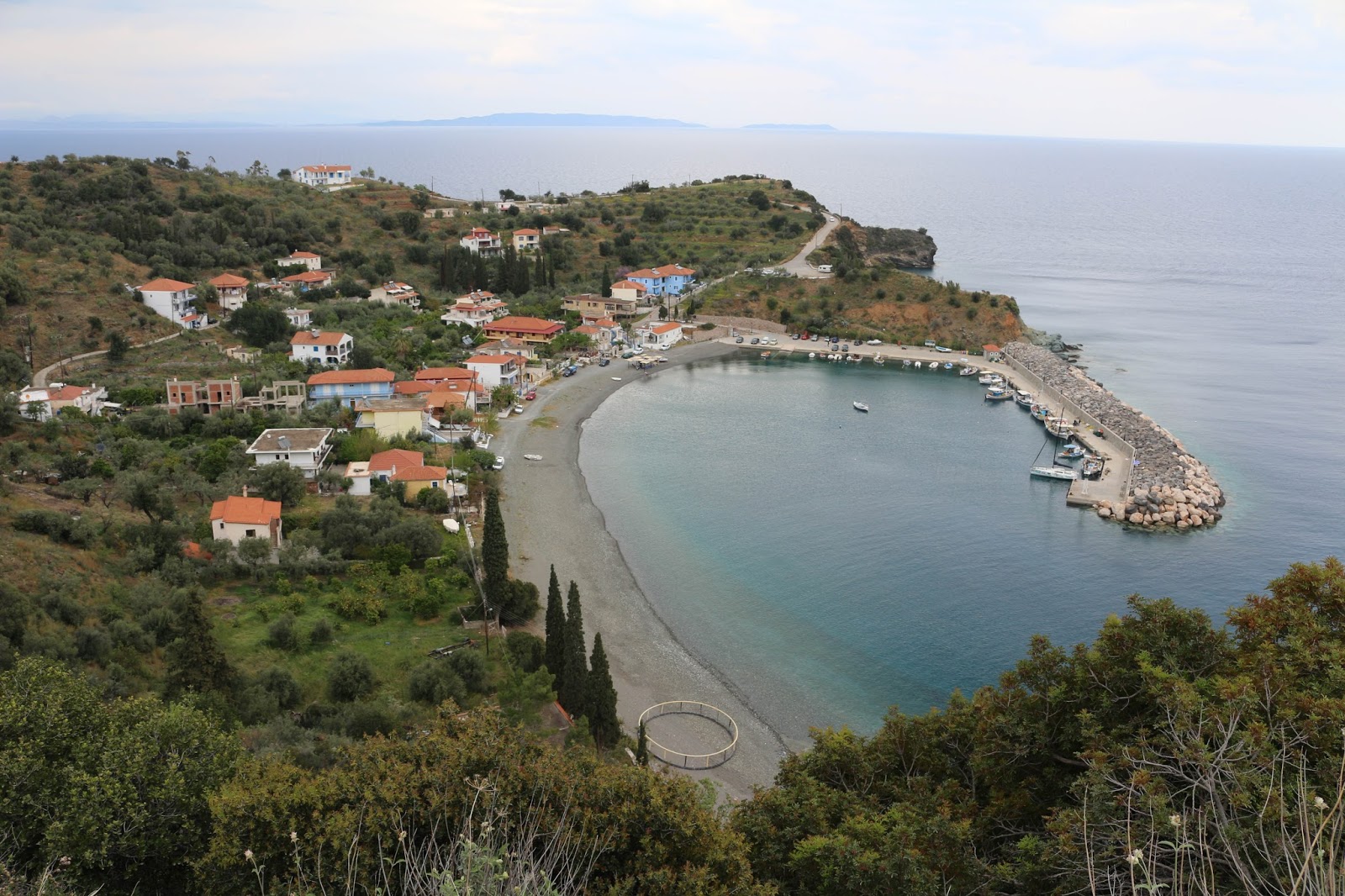 |
| The road went up and down along the coast, giving us the first real hill-climbing challenges of the trip. But scenic views are always the reward. |
 |
| A great free camp in the narrow canyon outside of Leonidi. The next day would be a 3,000+ foot climb up the canyon and over the pass to the other side of the mountains. |
 |
| The day of our climb was bright and beautiful, with a spectacular view of the monastery built on the cliff. |
 |
| A closer view of the monastery. |
 |
| Beginning the climb. |
 |
| Go Ann, go! |
 |
| View of the switchbacks we have already conquered. |
 |
| Last big hairpin turn! |
 |
| Victory! |
 |
| At the top was the incredibly quaint town of Kosmas. |
 |
| Joe would have liked nothing more than to settle into a hotel room and eat the moussaka of his memories from when he cycled through Greece in 1979. But we still had 55 kilometers to travel that day to stay on schedule. |
 |
| But we dropped quickly to the drier west side of the mountains. |
 |
| We made it to Mystras just as the sun was setting. Our campground host took pity on us, and gave us a ride to the fancy resort and spa down the street for dinner. Still tired the next morning, we opted for a taxi to take us to the uppermost entrance of the ruins. |
 |
| Joyful and happy tourists! |
 |
| The archeologicial site of Mystras is sprawled over the hillside, and includes churches, monasteries, fortresses, a palace, and aqueducts. |
 |
| We worked our way down, from top to bottom. |
 |
| Frescoes on the ceiling of one church. |
 |
| A patchwork of stone and brickwork on one church exterior. |
 |
| The structures were used by several civilizations over the centuries, and recent preservation keeps them standing. |
 |
| Back on the road, we ended up have a challenging day, riding through hill towns after climbing from the valley bottom. We tried to avoid this route by taking the new toll road down the center of the valley, but got stopped by the safety officer and escorted back a few kilometers to the nearest exit. There were no signs saying bikes were not allowed on the toll road, and John had talked to the locals, who seemed to think it was not a problem. Now we know. |
 |
| The glorious thing was many of the towns have free-flowing fountains of spring water, icy cold. |
 |
| Our campsite that night was the courtyard of a church near Megalopoli. We were ready to set up camp in a grassy field, but a shepherd on a motorbike came by and indicated he was bringing his flock there for the night. Speaking no English, and we no Greek, we somehow came to understand he knew of a better place, across the river with toilets and running water. He then led us there, to the church, where we respectfully settled for the night. |
 |
| A wonderful old sycamore graced the courtyard with seating for a celebration. |
 |
| Just beyond our church campsite were ancient ruins, in the shadow of the plume of a power plant. The old and the new. |
 |
| Another tough day through sleepy hill towns. |
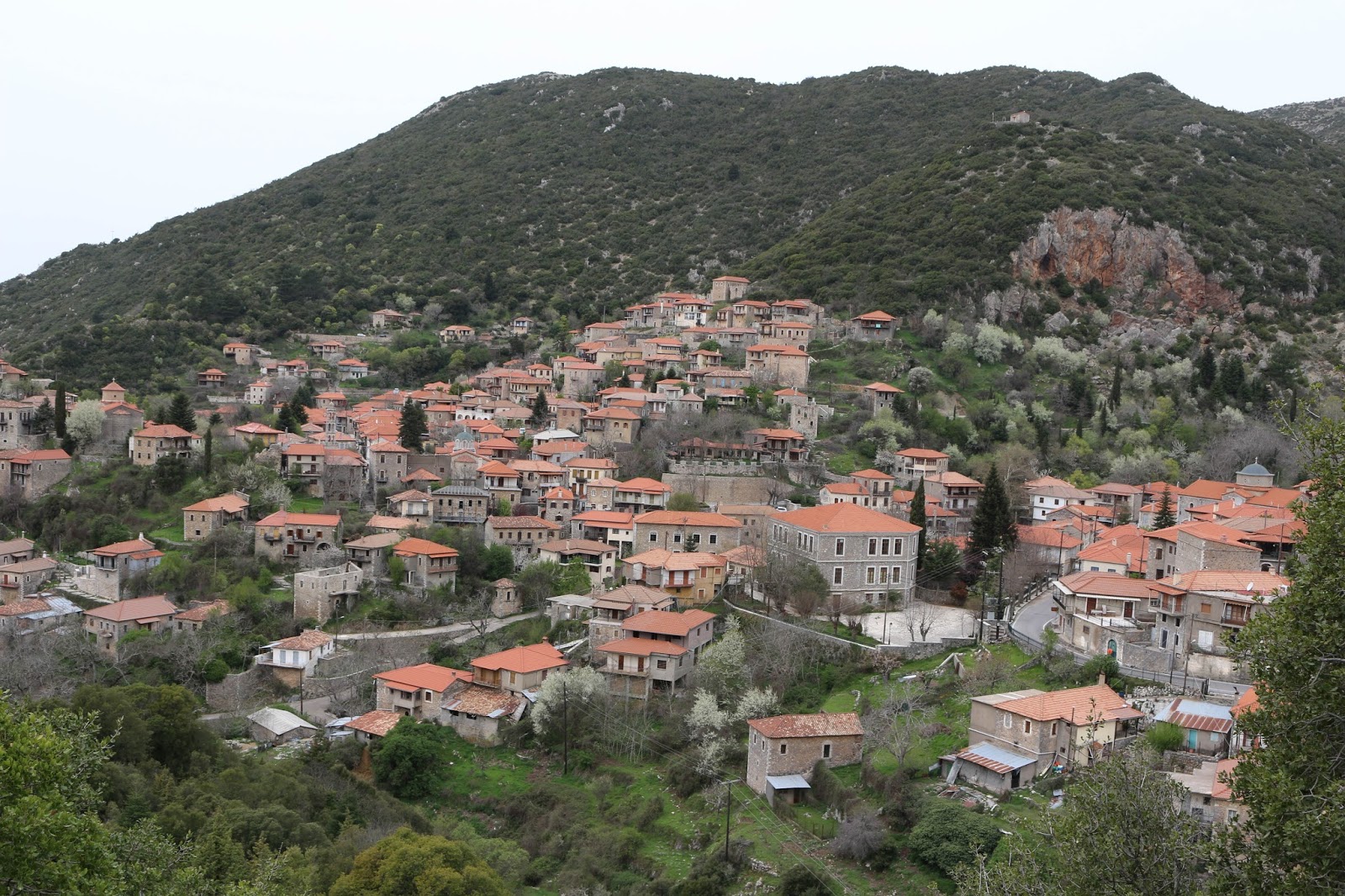 |
| Red brick roofs of the village of Stemnitsa. |
 |
| Narrow streets of Stemnitsa. |
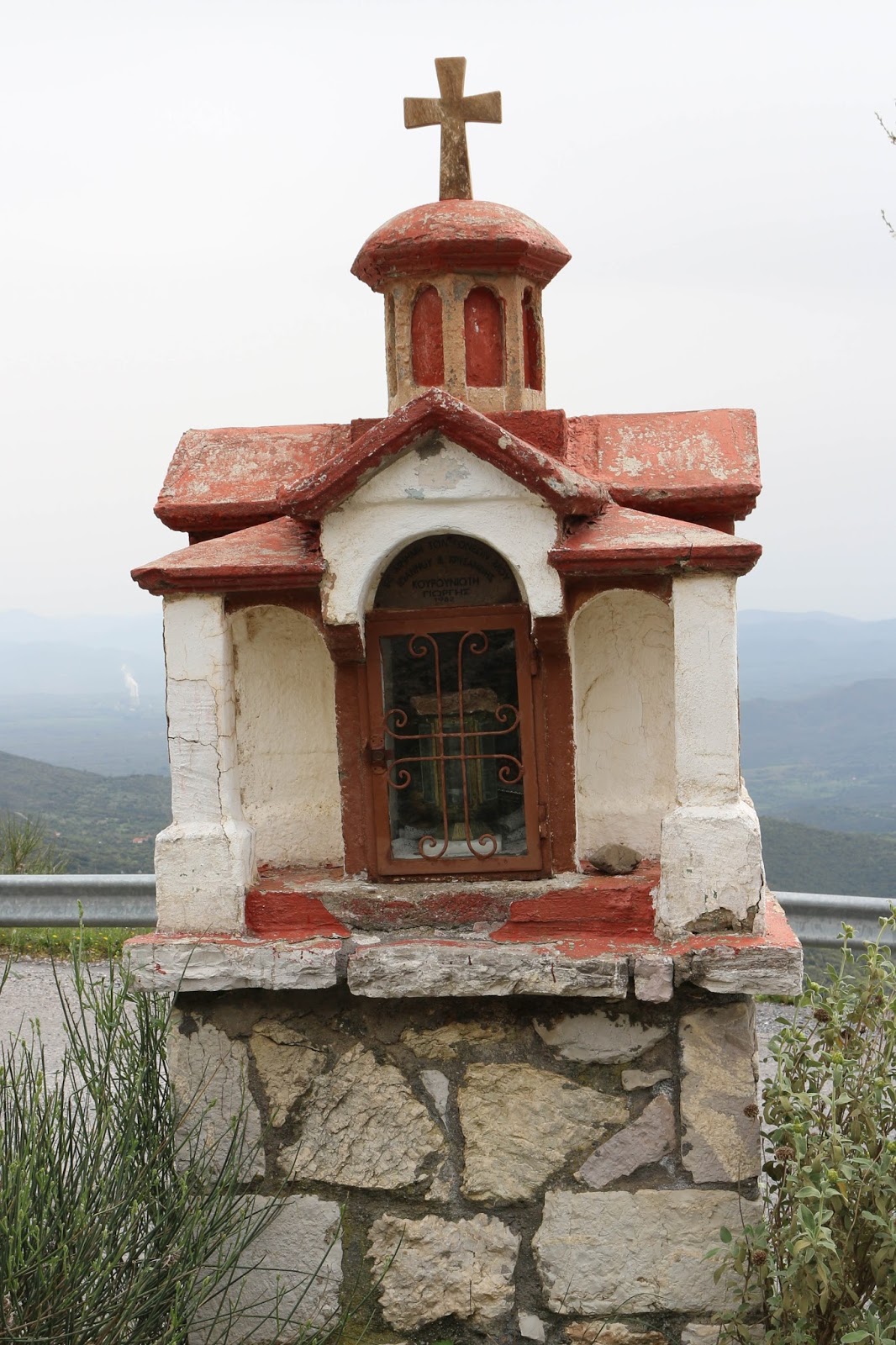 |
| All over Greece are roadside shrines, often at dangerous curves or intersections where someone has died in an accident. |
 |
| Taking a breather as we begin our descent. Thankfully it was a cool and overcast day, making the climbs of the morning much more tolerable. |
 |
| Our best free camp yet, in a pine forest reminiscent of Oregon. |
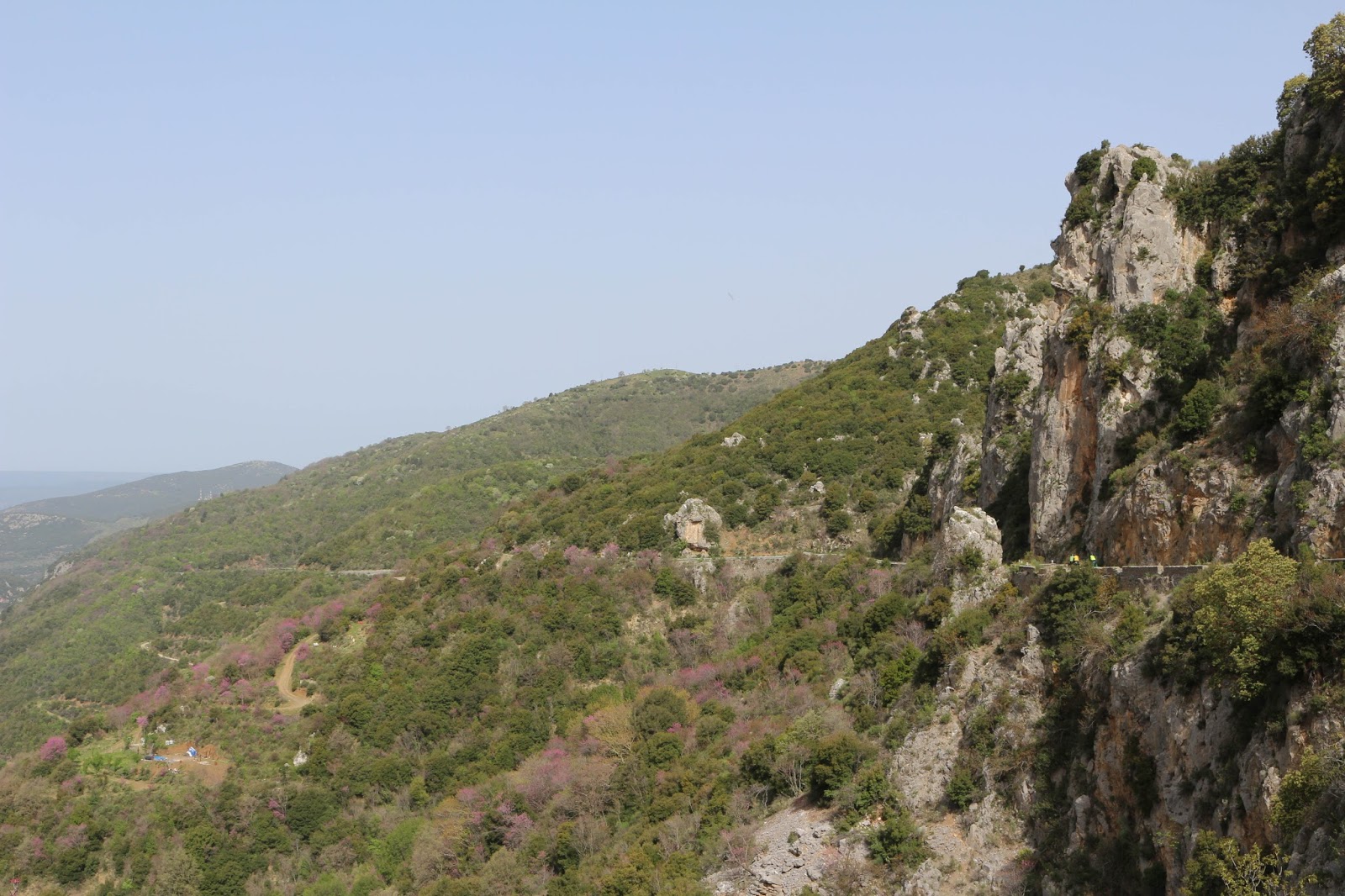 |
| More descending...if you look closely you might see three neon-vested cyclists. |
 |
| It was hot and sunny once we got to the lower elevations of the Eymanthos River on our way to Olympia. Some cyclists have been known to skinny-dip in this river. |
 |
| Another day off the bikes, walking among the ruins of Olympia. |
 |
| I now have seen Doric columns, and can identify them in the wild. |
 |
| Like this one. |
 |
| Olympia was the site of the Ancient Olympics, which lasted for over 1,110 years. The Olympia ruins are the site where the athletes trained and competed. This is the stadium where footraces were held. |
 |
| The museum at the site had the reassembled sculptures of the pediments of the Temple of Zeus. |
 |
| The pediment sculptures were one of the most amazing things we saw at Olympia. |
 |
| Cycling again through sparsely populated agricultural areas on our way to the coast... |
 |
| ...where pavement turned to dirt on occasion. |
 |
| An early-afternoon campsite next to probably the only reservoir in the Peloponnese. The water was too stagnant for swimming, and we camped next to an abandoned sand and gravel operation. Not the prettiest place, but the trees provided shade to escape the heat of the afternoon. |
 |
| Our final day of cycling together, skirting the massif of the local high point. |
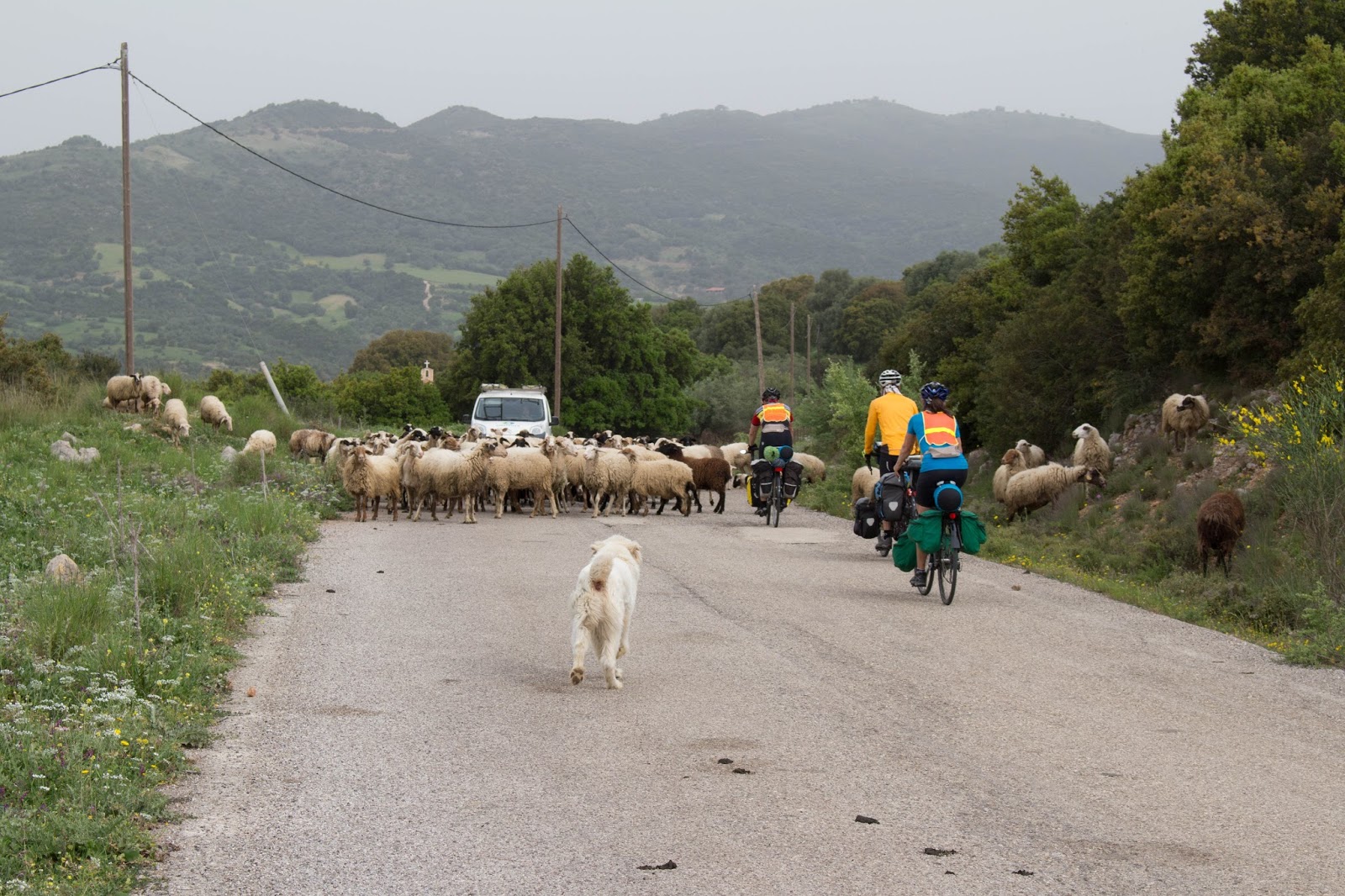 |
| Where sheep serve as traffic speed control. |
 |
| Lunch on the beach. We will miss traveling together with you, Joe and Ann! |


