Saturday, April 11, 2015

Castets en Dorthe, France: Canal Journey, Part 2


One of the many lock stations on the canal.
After two days of hotel bliss and city comforts in Toulouse, we merged back onto the canal route located just across the street from where we were staying.  The trail was busy with bike commuters and pedestrians on their way to work.  We headed north and soon transitioned from urban to industrial.  We passed factories and a few homeless camps, paralleling the train line with the hum of the freeway in the distance.  It was not long until we were again cruising along the canal, virtually alone, with the rural landscape peeking between the trees that endlessly line the canal shore.
Four modes of transport, all in a line -- rail, road, bike trail, canal.

Serene cycling...
This section of trail after Toulouse is known as the Canal latéral à la Garonne portion of the Canal du Deux Mers because it follows the Garonne river, a significant waterway that eventually leads to the city of Bordeaux and then to the Atlantic Ocean.  This portion of the route had more intersections with roads that required us to frequently climb short, steep pitches to get to the level of the overpass and then roll as sharply down the other side.  And most remarkable of all were the places where the canal actually had its own aqueduct that carried the water over the Garonne and its tributaries 7 times along the route. The two most significant are the Agen aqueduct, 600 metres long with 23 arches and the Cacor Aqueduct at Moissac over the River Tarn, 356 metres long with 13 arches. Completed around 1856, they do their job splendidly and don’t appear to leak, a feat of engineering.
Water over water -- the Cacor Aqueduct at Moissac

Nuclear plant near Valence d'Agen

...and more serene cycling...

Mustard plants, as a crop.  They are weeds at home.
We cycled two more days along the canal.  We had to venture off the trail in search of groceries one afternoon, and leaving that safety and serenity was like leaving the womb.  Negotiating traffic circles and sharing the road with cars and all the other realities of a big scary world.  We followed signs back to the canal and the campground we planned to stay at, and once again, we were early and it was not open.  But there was running water and mature hedges and a lone travel trailer that would conceal us from the road.  So we hunkered down and encountered no one after sunset.
Crossing the Garonne in search of provisions.

Our little hideout for a night.

Mossy bridge, one of many.

...you get the idea.

Another typical lock station.  The blue sign shows the names and distances to the next locks to the east and west.
The Canal du Deux Mers officially ends in the town Castets en Dorthe, but it is possible to connect various bike routes to the city of Bordeaux.  We chose to exit at this location, and after 12 kilometers, were back on a bike “rail trail” that proceeded southwest through the forest to the coast where, we were told,  there are shifting sands.  We managed to cross most of southern France, 375 km (225 miles), on dedicated bike trail.  And not even considering the route is flat and scenic and historic, just this fact makes it one of the world’s greatest rides.

Wednesday, April 8, 2015

Toulouse, France: Canal Journey, Part One


Getting started on the Canal du Midi
It is possible to cross southern France by boat, from the Mediterranean to the Atlantic, on the Canal des Deux Mers (Canal of the Two Seas).  The canal has two parts -- the portion east of Toulouse is the Canal du Midi, built in the 17th century, and the Canal latéral à la Garonne, built in the early 19th century, is the west portion.  And there is a paved bike trail along the almost flat trace of the route, virtually the whole length of the canal. Along the waters edge are the evenly spaced trees planted to keep the banks in place, and we followed these guideposts of the Canal du Midi out of Carcassonne.

Unfortunately the paved trail petered out into a single-track dirt path that we had to push our bikes to get through.  We had found the one section that has not yet been upgraded, so we whipped out our trusty Michelin maps and navigated to the town of Avigonet on traditional roads.  We found our first municipal campground, empty but for a couple of camper vans, clean and charming.

One of the locks on the canal
After a very chilly night (high-30s, max).  But at least there was no wind. And we were off on the official trail, completely separated from traffic, cruising on the most even grade a cyclist could pray for.  The only interruption were locks, spaced every few kilometers, with their station buildings, each one with its own unique character.  Operators would magically appear from somewhere whenever a boat approached the lock.  Barges were parked along the banks.  Some were small, but most were big, wide, shallow affairs.  They had the appearance of full-time occupation, with bikes strapped on the railings for the owners to pedal into local towns wherever they may moor along the canal. 
Old and new view from our campground in Avognet

Another fine morning on the canal

Signs like these with the names of the locks and distances were posted at regular intervals

The old trees are just starting to bud leaves, and they must provide nice shade in the summer
Some of the more tidy barges on the canal
Sweet boat!
As we got closer to the city of Toulouse, the barges got a bit more scruffy with a look like they have not moved in a long time.  We approached from the southeast and through an area of industrial and office parks.  It was near noon and the Canal du Midi path was congested with office workers out for an hour jog or cycle.  Toulouse is the fourth largest city in France and the center of its aerospace industry so there were lots of desk jockeys getting out in the fresh air on a sunny day.  With no camping options near the city center, we opted to stay in a hotel for a couple nights (yeah, Ibis!).  Once we left the trail to get to our hotel, we had no problems getting around in another superbly bike-friendly city.

We had a day to explore the downtown, and opted to look at the many fine old buildings, the cathedral, and take in the Musée des Augustins. A few images are offered here...

Building on a slice of a lot

Colorful!

Basilica of St. Sernin
Basclica window and shadow

More interesting buildings


A bit of French anxiété

The museum is housed in a former 14th century monastery

Meticulous painting restoration -- they both were tuned into iPods

Interesting display of Romanesque pillar ornaments

The Red Room

Gargoyles in the cloister, oh my!

The museum garden in the former cloister

Sunday, April 5, 2015

Carcassonne, France: A New Old Town

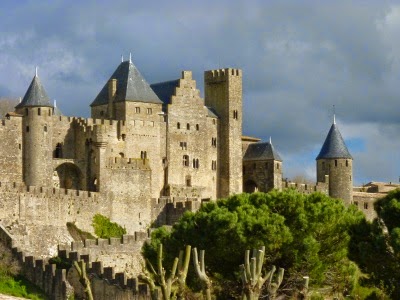
Carcassonne is a fortified city, centuries old, restored in the 19th century to look, from a distance, like something from a fairy tale.  But once inside the walls it is mostly souvenir shops and cheap cafes.  We went up the hill in the early morning to beat the tour bus crowds and take pictures in the flattering light, venturing inside only to look at the cathedral and the panoramic views.  Those fortified walls keep the tackiness and tourists confined, but walk around the outside and you can almost put yourself back in time.

Here are a few of our favorite images...


Saturday, April 4, 2015

The Aude Valley, France: Limestone Vistas


Last view of the Pyrenees as we go over hill and valley.
 To acquaint us with the country where we planned to spend three months, we both read “The Discovery of France: A Historical Geography” by Graham Robb.  The book describes the disperse tribes and languages that existed in the mid-19th century and the forces up until World War I that unified the country.  Highly recommended.  Mr Robb did much of his research for this book traveling the rural landscape by bicycle.  He is also a geologist, so when he writes of the Pech de Bugarach and the landscape around it in glowing terms we trusted his credentials and planned our route to pass through the area on the way to Carrcassonne.
John descending.

Old vines and new flowers.
The  wind was still blowing in the morning we left Perpignan but we were soon shielded by the topography of hills and valleys on little winding roads.  We arrived early in a sweet little campground that just opened -- they were still hosing the place down.  We did some much needed laundry and settled in for an afternoon of quiet.  Late in the afternoon the calm was interrupted by multiple cars parking and the sound of voices and laughter as a couple of dozen young adults descended on the remaining tent sites and instantly set up their pop-up tents.  Worried about their proximity and volume, John strolled over to investigate.  He immediately engaged a few who spoke English, and asked if they were on a geology field trip.  With  amazement they said yes, how did he know?  They were geology students from the university in Toulouse on a paleontology trip to find and age fossils in the limestone formations in the vicinity.  So with our geological past we became people of interest, and we chatted with several of them throughout the night, learning about their country, how it is to attend university in France, how old the rocks around us were, and that we were one hour behind the rest of France for the last three days because they just switched to daylight savings time.  They respectfully kept the party noise down as we went early to bed. 
A glorious morning descent.
The next day the wind was still blowing, not as hard, but still present.  We decided wind around here is the default condition.  We cycled west and threaded around the high tilted beds of limestone.  The focus of the morning were the ruins of the ancient fortress of the Peyrepertuse Castle still perched along the ridge where the Cathars made their last stand in the 13th century.  When we got to the north side we could see light coming through openings in the fortress walls.  By afternoon the castle was in the rear view mirror and Peche de Bugarach was in our sights.  It was a deceivingly steep grade, but with fine views of the peak at the pass and a glorious downhill to the campground.
A fortress ruin guarding our path.

It is hard to discern the castle ruins from the rock formations, but it is up there.

Approach to Peche de Bugarach

Vistas from the pass means no more uphill!

As close to Peche de Bugarach as we can get.

And, once again, we arrived on opening day.  In fact, we were the first visitors of the season!  The proprietor was cheerful and welcoming.  We inquired about a place to buy groceries, and he said the market in town was closed for the afternoon of Good Friday.  The disappointment of realizing that we might have to cycle to the next town, nine kilometers downhill and another nine back up late in the day must have been apparent.  He said he was driving there anyway so he offered to buy us food, just give him a list.  The views were great that day, but we remember that act of kindness the most.

Our new friend Victor!

Old growth vines every way you turn!
Rain delayed us the next morning for an hour and a half.  We retreated to a clear plastic tent, maybe left standing from some family reunion last year, and cooked breakfast.  When the skies cleared we left our bubble of opportunity and started our descent and approach to Carcassonne.  We rode through miles and miles of vineyards, old and gnarled.  We met Victor, from Portugal, who cycled the last week from Bordeaux, taking an unladen day to bike into the city.  We cycled together and chatted until we saw the towers Carcassonee on the horizon.  And there was a sign to a campground on the left, within walking distance of the old city.  And so another day of bike touring ended with only pleasant surprises.
First glimpse of the towers of Carrcassonne


Wednesday, April 1, 2015

Perpignan, France: Deja Vu


Heading to France with the snow-capped Pyrenees in the distance.
The Pyrenees mountain range separates France from Spain.  The Tour de France crosses the Pyrenees, and so must we.  But John and his excellent planning found a route that would avoid the higher elevations that we could see in the distance, glowing white with snow from the recent storms.  This route sneaks around the eastern end through the towns of La Jonquera on the Spanish side and Le Perthus on the French side.

It seemed most of the traffic was on the toll road, but we followed a secondary highway that roughly paralleled it.  Light traffic and courteous Spanish drivers made it easy enough.  There were numerous truck stops along the way with food and fuel opportunities, as well as a few sex shops. At one lonely intersection woman in platform shoes, leopard tights, and big hair dancing to music from the boombox next to her was also trying to attract some business.
Our first pique nique in France!
The pass was a gentle, easy grade, but then just as we crossed into France, it became narrow, steep, and lined with all kinds of shops selling t-shirts and cheap junk.  We huffed our way up with cars trying to get around us.  But once we crested to the top of the pass the commerce zone ended, the congested traffic dissipated, and we coasted down a winding road with fine views in many directions.

By noon the wind was picking up.  We knew of a municipal campground on a lake and we were on track for an early afternoon arrival.  When we got there the wind was howling and there were whitecaps on the lake and the campground was closed.,  Deja vu.  Due to open on April 1, which was the next day.  We peeked through the fence and saw someone zipping around on a golf cart.  We found an open gate and let ourselves in and rode around looking for someone.  Surely they would take pity on two cyclists caught in terrible crosswinds.

We eventually found a teenage girl, who was very surprised to see us.  We asked if we could stay, even though they were not yet officially open.  She said no, no, no, it was not possible, no, no.  We got the message, and after getting vague directions to the nearest hotel, we braced ourselves to ride into the wind.

The gusts were approaching 50 mph when we got out in the flats or anywhere that was slightly elevated.  At times we could not ride and had to walk the bikes,  We hunkered down at one point behind a concrete barrier and pulled out the Lonely Planet brick and saw there was a hostel in Perpignan, usually an inexpensive option.  It took us two hours to go 10 km, crossing the city with blasting wind, heavy traffic and few bike lanes.  We finally found the hostel, pulled up to the gate, and we both could not believe the sign stating that the hostel was permanently closed,  Deja vu all over again.

We went a few blocks, saw a hotel, and John went in and asked how much. One hundred plus per night, but if we wanted a less expensive option we could go around the corner and there was another hotel.  So we rolled  over there, went to the desk, and it was the same clerk that John had just talked to.  There was a hallway connecting the two reception desks -- both hotels were operated by the same company.  This one was 46 euro a night, and no problem taking our bikes inside the room.  It was getting dark at this point, so we checked in.
Our little haven from the windstorm.
The room was a marvel of efficiency.  A queen bed with a bunk above took up one half of the room, and the shower and a center fixture with a vanity on one side and a desk-like platform on the other.  The WC was its own sanctum with a door.  The wind howled outside all night, and it was still howling the next day, so we stayed another night.  We spent the day walking around the old core of the city, eating our first French meal of the most perfectly prepared crepes, and sucking up the wifi.  It all turned out fine in the end, and anytime John wants to stay in an Ibis hotel, I’m all for it.
Wonderful buildings in the hear of Perpignan's old center.

Many of the building exteriors are decorated with local rounded river rocks.

Cemetery/cloister in old Perpignan.

More wonderful narrow streets.

Translate

Copyright

All original text and photos are copyrighted Doris Reilly © 2006-2023. No part of the content or the blog may be reproduced without prior written permission.
Powered by Blogger.

Contact Form

Name

Email *

Message *