Friday, January 21, 2011

Te Anau, NZ: A Fiordlands Journey

Te Anau is a town built for tourism. Not big, but full of accommodation options, eating establishments, and booking agencies for access to the Fiordlands and the premier tramping routes in the area.  Here we were on the edge of yet another very unique section of this small country -- the Fiordlands -- virtually inaccessible except by air or boat or by a few trails that thread their way between huts.  Carved by glaciers that etched deep canyons out of the granitic rock, it is a terrain more familiar in Norway, and a destination for just about every tourist visiting New Zealand.  Including us.

Most tourists choose to take a couple hour boat cruise through Milford Sound.  The boat originates from the dock at the end of the dead-end Milford Road.  Getting to the dock requires going over a pass, through a 1200 meter plus long tunnel, on a narrow road with a constant flow of tour buses passing, through an area that gets 20 feet (feet!) of rain a year.  And then coming back again.  What would you do?  The last cyclists we met rode in and took the bus back out.  We chose to take a tour bus/cruise combo for a one-day trip to save our bodies to continue our journey beyond Te Anau.

Our bus and fellow passengers for the day.
We selected the least expensive package, but ended up with the best tour guide.  Simon, a former conservation worker, was well-versed in all things about the natural history -- the plants, the birds, the geology.  He traded in the life of constant travel and low wages to provide for his family, and live a simple life on the shores of Lake Te Anau in a cabin without electricity.  John sat up in the front seat of the bus next to him, and chatted with him most of the day.  Not only about what we would see out the window, but about trails and tramps and routes to explore in the region.  The drive took longer than the cruise, and depending on the group's interest, Simon would make frequent stops at vista points and natural spots.  He showed us wild black orchids, one of only four growing in the valley on the way to Milford Sound.

Mist was lifting and rising all day on the surrounding peaks.

Aptly named -- Mirror Lakes.

Rushing water emanating from the glaciers high in the mountains, with the distinctive turquoise tint from fine glacial silt.

If I were a true German, I would jump into this icy pool naked.

One of the reasons we did not bike the Milford Road -- Homer Tunnel.

Meet one happy boy -- he has been quaking with anticipation of seeing Milford Sound since our journey was just a concept.

The waters were like black glass.

Waterfalls cascade from a hanging glacial valleys.

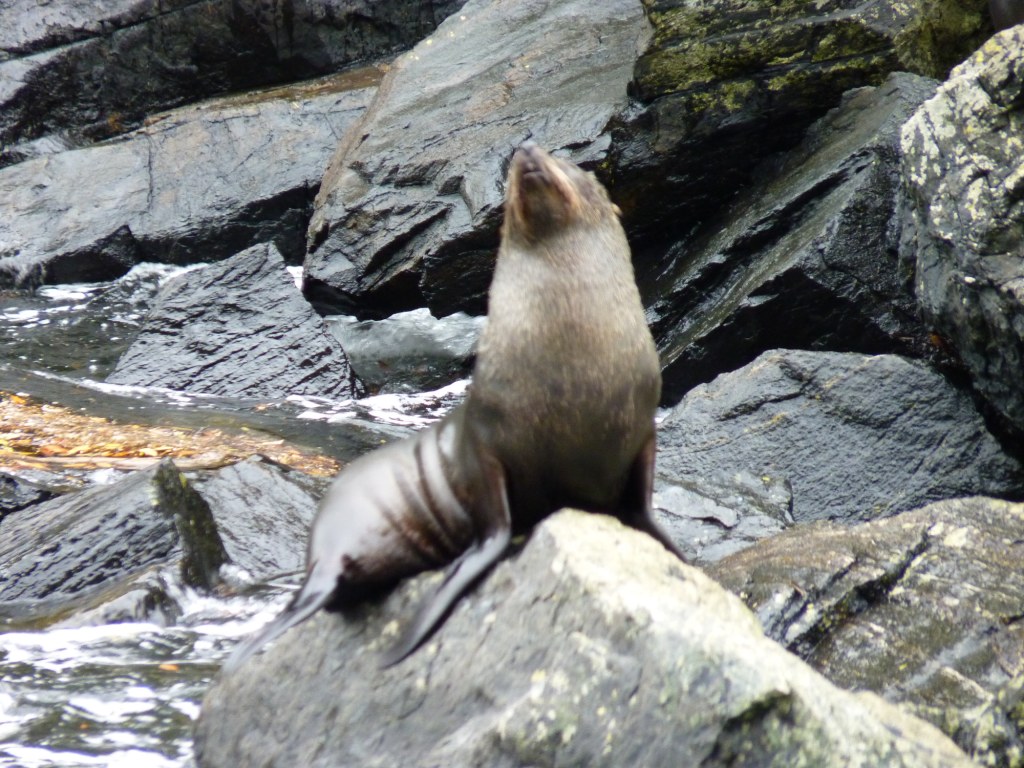
Seals greet us from the shore.

The boat passes under a waterfall.  Only a couple folks in our group frolicked in the cascade.

Water, water, everywhere.

Twenty feet of rain per year = lush rain forest.

Glacier view.

A Kea, the native, rare everywhere except in tourist centers where they might get a handout.

A parting view at the end of a most spectacular day.

Wednesday, January 19, 2011

Blackmount, NZ: Southern Hospitality

Invercargill was not a city we planned to visit, but my snapped shifter cable changed the itinerary. We arrived late Saturday, and the bike shop not open until Monday, we occupied ourselves by blowing our wad at the local farmer's market and visiting the amazing Queen's Park.  First thing Monday morning, we were in the bike shop.  Within five minutes my bike was up on the rack and complimentary cappuccino was brewing -- $22  and a half hour later we were on our way.  By this time I also had not a twinge of shin muscle pain, so it looked like both bike and body were cured.  The next day we were on the road early in the morning, taking the Southern Scenic Route towards Te Anau.

Things are finally going our way!
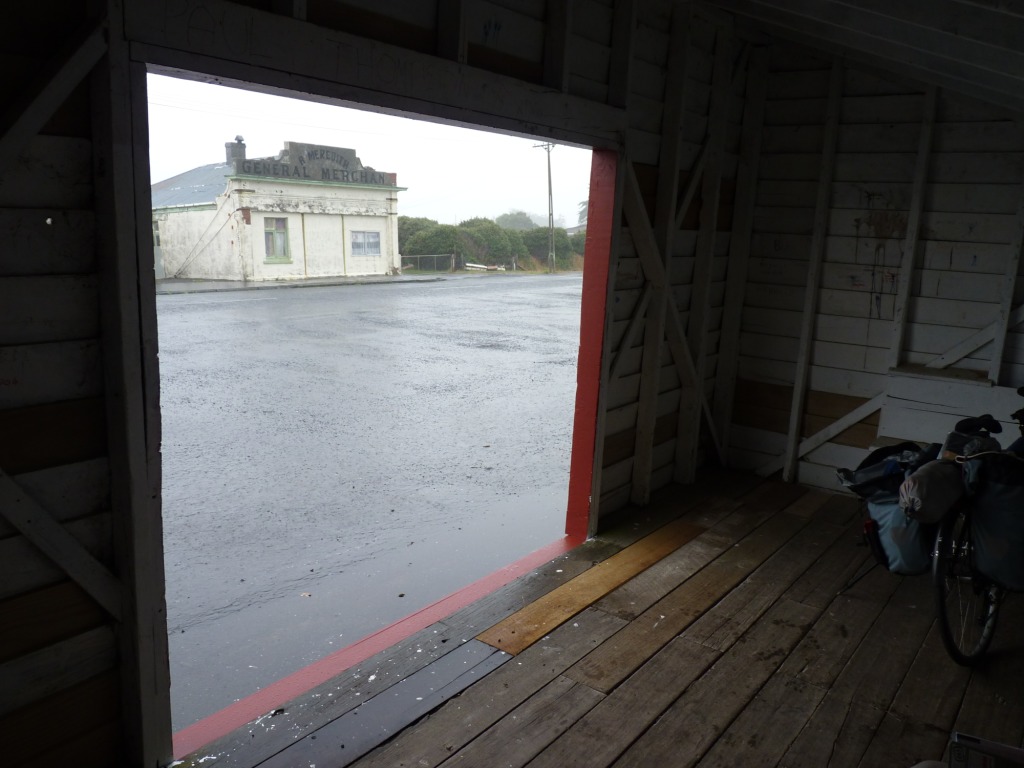
Despite the formal designation, the route in this part of the country is rural and remote, and greatly reminded us of our time on the West Coast.  Campgrounds were a bit widespread, and we figured we might be able to find a place to free camp along the way.  Just as we made a late afternoon stop at the park in Orepuki for a restroom break and to fill our water bottles, it began to drip.  Drips turned to rain, and we ducked into the bus shelter across the street to wait it out.  Minutes turned to hours, and the rain did not stop.  Since only two cars passed in the last five hours, and it was a rather spacious bus shelter -- it seemed like half the size of our place at home -- we decided to go ahead and cook dinner.  The rain continued, the wind howled, the sun set, and no more cars passed,  So we just went ahead and set up the tent inside the shelter to spend the night.


Shelter and seating -- what more could you ask for?

Weather kept happening into the night.

The next morning we went out to fabled Gemstone Beach -- no gems, just horrendous winds blowing foam across the sand.
It took is an two hours to go 10 kilometers the next morning, as winds from the passing storm front was directly into our faces.  But as morning turned to afternoon, we turned inland so the headwind was now a tailwind.

Most of the sheep we see now have been freshly sheared, with the linear traces of the shearing blade evident.
Again, with no campground nearby at the end of the day, we planned to duck into the forest for the night.  But a big black cloud formed to the east, and another to the west, and both approached fast and coalesced before we could outrun it.  So public facilities once again came to our rescue.  We pulled under an awning in a schoolyard.  A local gentleman came by, walking his dog.  We asked, could we camp in the schoolyard?  No, that is not allowed, but if you wait a minute I will go get the key to the community center next door -- you can stay there.  The rain has started, and it won't stop soon.  So just like that, we had a cavernous hall with a kitchen, hot water, and a heater to ourselves for the night.

The trust and kindness of strangers are amazing.


We spent the night at the foot of the stage on a beautiful polished wood floor.

The clouds broke up just before bedtime, painting the pastures in the distance with light.

Friday, January 14, 2011

Curio Bay, NZ: Catlin Treasures

The further south we traveled, the more frequent were those, Kiwis and tourists alike, who said "visit The Catlins".  We decided to go for it, but it seemed forever to get here because of that pesky leg injury.  But we cautiously entered the region after the layover in the "hospital hostel" in Owaka by doing a few short cycle days.

Beaches, rocky headlands, good surfing, and remoteness are all part of the character of the place.  Many of the small roads were unpaved until just a few years ago, so there currently is a perceptible increase in tourist services development.  But much of what is here is still on the minimalist side, and there are broad areas of rural, isolated country and a bit of the beaten track of the standard tourist with limited time.

A half day of cycling south of Owaka brought us to windswept Tautuku Bay. the wind was blowing so hard the waves were being pushed back as they came into shore.

A minor stream crossing and a roll across the sand found a free campsite well protected from the wind and with an ocean view.
Our recollection from looking at a geologic map of the area was the "basin and range" character of steeply dipping sedimentary rocks on the highlands separated by valleys.  So traveling south to our destination of Curio Bay included a few steep climbs, which got the leg to barking.   But the sun was shining, and any day that happens is a cause for joy.


We were racing to get to Curio Bay by early afternoon, because at low tide petrified trees are exposed on the rocks in the tidal zone.  And somewhere on the second to last grade there was a snap, and I no longer could shift gears.  We pulled to a grassy stretch of ground, and spent the next hour trying to thread a spare cable through the shifting mechanism.  Let it be known, the wire cutters on a Leatherman tool are insufficient for trimming bike cables.  We finally knocked on the door of the house that we were parked in front of and begged for a more adequate tool.  Within seconds the homeowner retrieved a cutter from the front floor of her car (only in the land of infinite fences -- her partner works as a fence builder).  We spent another half hour chatting it up about local politics, bike travel, and the uselessness of television while John finished the job.  But the shifter worked only for three gears.  Enough to get us to our immediate destination, but not to the bike shop, at least 100 km away.  And since our new friend also works for the local tourist information center, we got the scoop on catching a bus to a town where we could get the shifter serviced.

It finally was late afternoon when we arrived at Curio Bay.  The tide was still out, the sun was still shining, and the petrified forest was beautifully exposed and lit for our exploration.

Tree trunks are scattered like pick-a-sticks.  The forest was flooded by volcanic debris and covered and silicified during the Jurassic period.

Tree rings can still be seen in some of the logs exposed in cross section.

Stumps of the felled trees pop up everywhere.

Many of the stumps have a cylindrical core of silicified wood, surrounded by a cone of ash.
Curio Bay also has rare wildlife -- Hector's Dolphins, Southern Right Whales, and also Yellow-Eyed Penguins.  The birds waddle up on shore in the late afternoon.  Not to look at petrified trees, but rather to feed their young in nests in the bush on the shore.

The penguins at Curio Bay are remarkably tolerant of human observers.

Ready to dive in!
We stayed one night at Curio Bay, and made arrangements to take a tourist bus into Invercargill, the largest town in the Southland.  The transportation system moving tourists around the country reaches even the loneliest places, which was fortunate for us.

Waiting for the Bottom Bus to take us to Invercargill.
Although we would have preferred to ride the distance, it was not sensible with my injury to try with only three gears.  We traveled in three hours what would have taken us two days, and missed the challenge of 100 km/hr headwinds.  We hired seats on the Bottom Bus, one of the many transport companies with vehicles that seem all too frequent and pass all too close to us on the New Zealand roads.  And this was a cultural experience in itself.


The driver stopped once along the way and walked to the back of the bus to make sure the bike as still there.  My bike got to ride inside.

Our bus was occupied by 14 other passengers. They all joked around like friends, which apparently is what they were since they had been traveling on this bus together for a couple of weeks since Auckland. They were mostly girls from the UK in their twenties, all with iPods as fashion accessories, and more interested in flirting with the bus driver and playing DJ for tunes on the bus speakers than looking at the landscape. When asked if they wanted to stop one more time to look for penguins, they replied with a "no, not really...they are cute and all, but we just want to get to the hostel". So we sat in the back of the bus, craning out the window to see every rise and fall of the terrain we could have biked, with little interaction with our fellow travelers. The contrast of our travel mode and experience was more stark than the generation gap.  We felt affirmed that we are, indeed, rich.

Tuesday, January 11, 2011

Owaka, NZ: Tibialis Anterior Blues

Like a good girl, I listened to my mother, and I ate my vegetables.  I listened to the physiotherapist in Dunedin, and he said I strained my tibialis anterior, and I am ok to bike because that muscle is used for walking downhill, not pedaling.  But what I really should have listened to was my body, which said that pesky shin muscle is not quite healed yet.

After a couple of days of rest in Dunedin we continued on, doing a loop to the end of the Otago Peninsula and then exiting the city to the south.  Some 80 kilometers and some steep hills later the leg was hurting, so much it was painful just to touch it.  But we were camped in a park on the beach, and we had to find a place where we could settle in for some quality healing time.  A couple of short days later, we were in Kaitangana, a tiny former coal mining town.

Here it is way off the tourist path, but the campground was cheap and quiet.  We were the only guests.  Ralph, our host and a German immigrant, has invested a money and year and a half of time to upgrade this modest campground, but the tourists do not seem to stop there.  So he opened a pizza parlour next door.  We planned to stay only one night since we did not have enough food to last longer.  But Ralph gave us some bananas, and we had pizza and beer for dinner, so the leg got another day of rest.


Ralph and his sweet daughter, Monica.
We hopped 12 kilometers further to Balclutha, the largest town in the District,  and the leg still said REST.  So we lived there for four more days.  We amused ourselves by reading, icing my leg, reading, icing, reading....you get the idea. 
 
We waited out some rainy weather during our break in Balclutha

The lounge in the campground was like a living room, and we had it to ourselves during the day.

When the rain cleared, we visited the bridge over the Clutha River, a local landmark built in 1935.

In need of a change in surroundings we did another short hop to Owaka, just 30 kilometers down the road.  Here we stayed two more days in a hostel that offered camping.  We arrived early afternoon, and the place was deserted.  A sign at the office said to make ourselves at home -- someone will be there later take our money. 

We wandered the empty halls - the place was cavernous.  A former hospital, it was converted to dorm accommodations only two years ago.  The original coal furnace is still used for space and water heating, taking advantage of the local resource.  If I were that kind of person, I might even think the place could be haunted.

We set up our tent on the spacious lawn in the backyard of the former hospital.

There is still a definite hospital character to the place, but the floors have been stripped of their linoleum and beautifully finished by the hostel operators.

One thing we could not figure out was shy some doorknobs were mounted so low...

...and others so high!

The kitchen where meals for many people for a very long time were prepared.

The coal furnace -- black coal dust covered the floor and every surface, and emitted a distinct sulfur smell unfamiliar to us when it was fired up.
And if I were that kind of person, I might think that being in this place, where so many people in the past have been healed, helped me recover, too.  After a day here of rest and ice, my leg feels almost normal.  We stayed an extra day, just to make sure.  But I think my leg is telling me to get back in the saddle.

.

Saturday, January 1, 2011

Dunedin, NZ: Done Eatin'

With something like 123,000 people, Dunedin is the second largest city in the South Island.  So what would be a forgettable small town in the States is anticipated by our current New Zealand reference point as going to the "big city".  Our plan was to stay just one night, get what we need, and head to a more remote section of the coast to hide from New Year's revelers. 

While treating ourselves to a rare lunch in a restaurant, rain began to fall...and fall...and fall.  So we decided to further indulge ourselves to a night in a hostel with a bed and a solid roof.  Dunedin is a blob of volcanic cones on an island of mostly sedimentary and metamorphic rocks.  So the topography, as we found coming into town, can be very steep if your road happens to go up the side of one of those cones.  And the hostel was on one of those roads.  No problem pushing the bikes up the last 100 meters.  But these 50-year-old muscles had a problem when we ventured out later on foot with our umbrellas to acquire foodstuffs.  Walking down the hill, I felt a pain on my right shin, and it persisted so I could barely stride normally.

One night turned into five as I nursed the injury.  A visit to a physiotherapist verified a muscle strain.  Lucky for us, the injury occurred while traveling in New Zealand, so the government kindly picked up most of the tab.  The treatment cost us only $21.  And we learned of this magic cream, which helped ease the pain remarkably.

So a bit of bad luck gave us a chance to explore some big town charms...


Claiming to be the "most photographed building in New Zealand", the still operating train station shows the prosperity of the city when it was build in 1906.

The lobby with its elegant architectural details.

Detail of the stained glass window on the second level.

Pillars fashioned from the same whitestone we saw in Oamaru, contrasted with rough-finished basalt.
Museums are also good diversions, and we visited both the Otago Settlers Museum and the South Otago Museum.  And sitting in the library sucking up free wi-fi, drinking cappuccinos, and finding the perfect wholemeal date scone made time pass quickly enough.  Dunedin is a university town, which accounts for 25,000 of those 123,000 people in the city. But the students were all gone for the holidays, so the town was very quiet, with none of the New Year's partying that we had feared.


Only a small exhibit was open at the Settlers Museum due to renovations, but the Art Deco building was a historical treasure in itself.

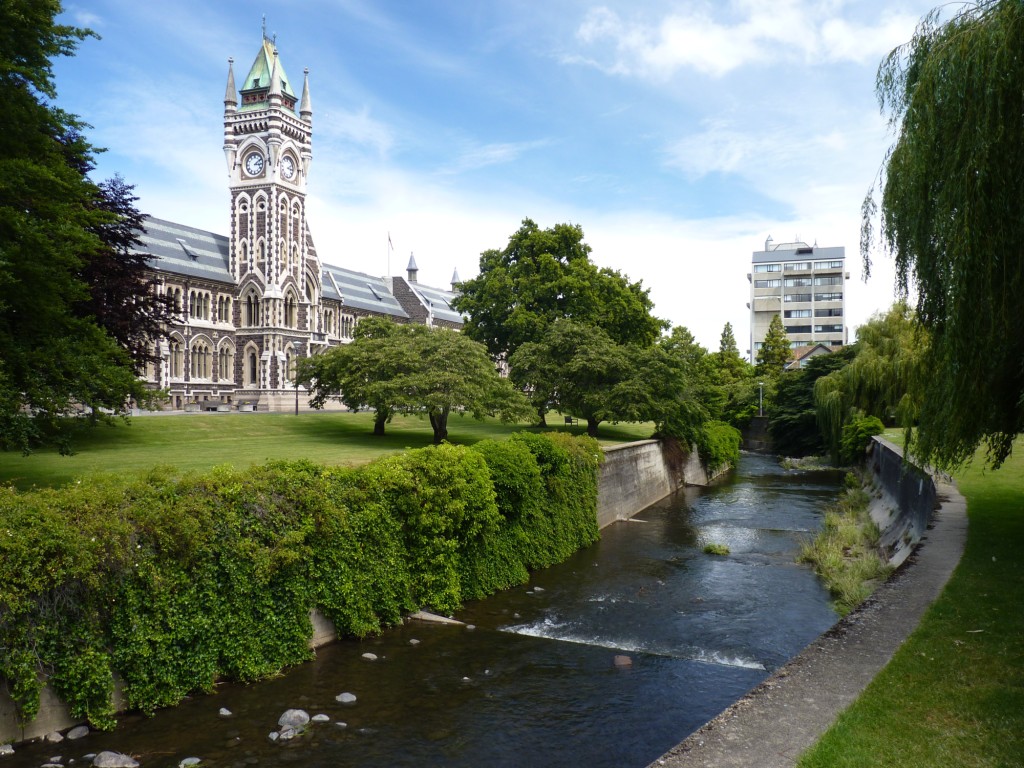
The buildings of the old core of Otago University share the same style as the railway station.

Appropriate that the Geology Department is housed in a building of basalt.

Whimsical gargoyles of various disciplines of study.
The pronunciation of the city name was tricky to remember at first.  Just looking at it, we would say "done-uh-din".  But it is correctly pronounced "done-eden".  And on our last day we visited the Otago Farmer's Market, adjacent to that old train station, and filled up our bags with those summer fruits just coming into season -- cherries, apricots, pluots.  And when we were finished there, we truly were "done eatin'".


Fresh picked "veges".

Stone fruits by the heaps -- with apologies to our friends buried in winter snow at home!

Kiwis are never far from a caffeine fix.  This truck-mounted cafe did a brisk business all morning.

Translate

Copyright

All original text and photos are copyrighted Doris Reilly © 2006-2023. No part of the content or the blog may be reproduced without prior written permission.
Powered by Blogger.

Contact Form

Name

Email *

Message *